Best Warehouse Exterior Cleaning for South Florida
A warehouse can be running efficiently inside while its exterior tells a different story. Mildew-streaked walls, blackened loading areas, dirty awnings, and stained concrete can make a well-managed facility look neglected. The best warehouse exterior cleaning is not simply the strongest pressure washer available. It is a planned approach that protects building materials, keeps operations moving, and delivers a clean result people can see from the street.
For property managers, owners, and facility operators in South Florida, that distinction matters. Humidity, salt air, rain, algae, and constant vehicle traffic create cleaning problems that do not respond well to a one-size-fits-all method. The right service starts by understanding the building, the surface, and what cannot be interrupted during the workday.
What Warehouse Exteriors Are Up Against
South Florida warehouses collect more than ordinary dust. Moisture supports algae and mildew growth on stucco, painted concrete, metal panels, exterior walls, roofs, and canopies. Near-coastal properties may also deal with airborne salt that leaves residue on windows, fixtures, and siding. Around loading docks, forklifts, delivery trucks, and employee vehicles add tire marks, exhaust film, oil spots, gum, and general grime.
These issues affect more than curb appeal. Slippery algae on walkways can create a safety concern. Built-up dirt around doors, dock areas, and drains can make routine maintenance harder. Organic growth may also hold moisture against surfaces, which is especially unwelcome around paint, caulking, and aging finishes.
A clean exterior gives visitors, tenants, drivers, and employees a clear signal: this facility is cared for. That matters when prospective clients arrive for a meeting, when tenants evaluate a commercial property, and when employees begin and end a shift at the site every day.
Best Warehouse Exterior Cleaning Starts With the Right Method
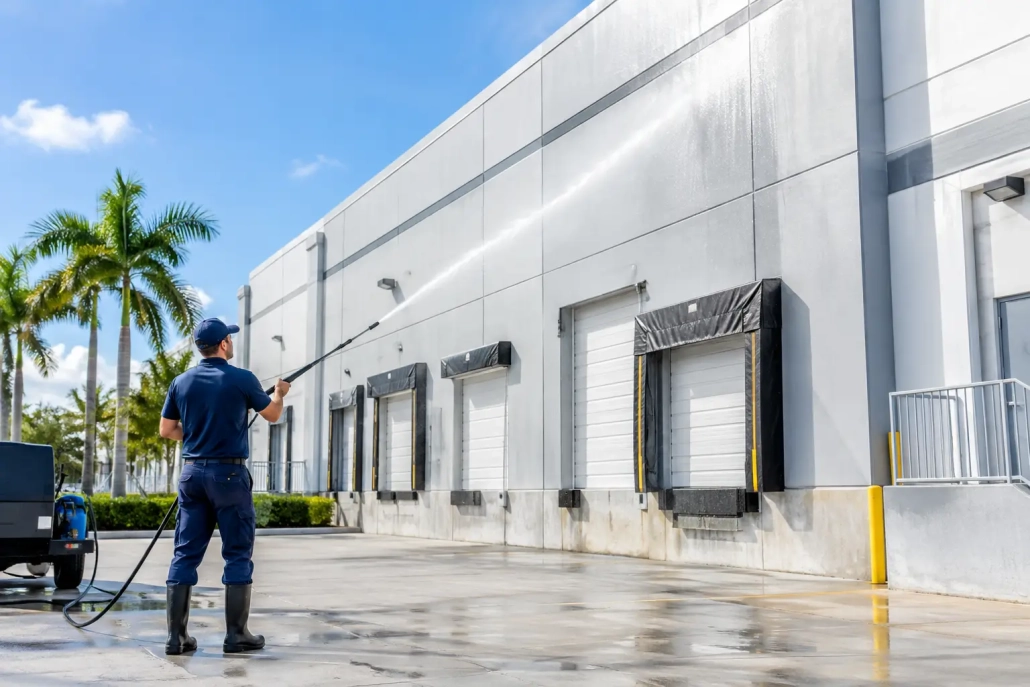
High pressure has a place in exterior cleaning, particularly on durable concrete surfaces such as drive lanes, sidewalks, and heavily soiled loading areas. But high pressure is not automatically the best answer for every part of a warehouse. Used carelessly, it can damage paint, force water behind siding or seals, disturb caulking, scar softer surfaces, and spread dirty runoff into areas that should remain clean.
A professional plan separates the property by surface type and soil level. Concrete may need controlled pressure and surface cleaning equipment. Painted walls, stucco, metal cladding, signs, awnings, and upper-story facades often respond better to a low-pressure wash paired with the appropriate cleaning solution. The solution does the cleaning work while low pressure rinses contaminants away more safely.
This is commonly called soft washing, although the exact process should be adjusted for the material. A good provider does not treat every stain with the same chemical or every wall with the same water pressure. They inspect the condition of the surface first, identify oxidation, failing paint, vulnerable seals, drainage paths, and nearby landscaping, then choose the least aggressive method that will produce a visible improvement.
Access Is Often the Real Challenge
Cleaning the ground-level perimeter of a warehouse is straightforward. Cleaning upper wall sections, tall windows, elevated signs, rooflines, and hard-to-reach facade areas is another matter. Traditional access can require lifts, scaffolding, extended setup time, blocked parking spaces, work-zone barriers, and coordination around truck traffic.
For many multi-story commercial buildings, drone-powered exterior cleaning offers a practical alternative. Specialized cleaning drones can apply low-pressure water and cleaning solutions to elevated exterior surfaces without placing a technician on a lift or building a scaffold system. That reduces access-related risk and can limit disruption around entrances, loading lanes, parking areas, and tenant operations.
It is not a replacement for every cleaning task. Ground-level stains, grease-heavy dock areas, and detailed work around entrances may still need hands-on crews and conventional equipment. The value is in combining the right tools. A warehouse may need surface cleaners for concrete, manual detail work around doors and drains, and drone cleaning for high exterior sections that would otherwise be costly or difficult to reach.
Keep Cleaning From Interrupting Operations
A warehouse exterior is part of an active workplace. Deliveries arrive, trailers reverse into docks, employees park, visitors come and go, and tenants may operate on different schedules. The best cleaning plan accounts for those realities before the equipment arrives.
Scheduling is one of the most useful ways to reduce disruption. Early morning, evening, weekend, or phased cleaning can keep a facility presentable without closing access to its busiest areas. A large property does not always need to be cleaned all at once. Dividing work by building elevation, dock bank, parking zone, or tenant area can help operations continue with fewer interruptions.
Water control is equally important. Cleaning crews should identify drain locations, avoid directing runoff toward occupied entrances, protect sensitive areas, and use methods suited to the site. Around loading docks, the team should coordinate with facility staff so pallets, vehicles, open doors, and active equipment are not exposed to overspray.
Clear communication matters here. Before work begins, a capable provider should be able to explain where crews will work, which areas need temporary clearance, how access will be managed, and what the site will look like when the job is complete.
What to Look for in a Warehouse Cleaning Provider
Price matters, but the lowest quote can become expensive if the contractor uses the wrong pressure, damages exterior finishes, creates a traffic problem, or leaves inconsistent results. Warehouses need a provider that understands commercial property conditions rather than one that approaches the work like a small driveway cleaning job.
Ask how the company will clean each material, not just whether it offers pressure washing. You should also ask how it handles upper-level access, nearby landscaping, windows, drainage, and work around active loading zones. If the building has stucco, painted surfaces, metal panels, or exterior signage, confirm that low-pressure options are available.
Experience with commercial scheduling is another useful indicator. The provider should be prepared to work around your operating hours and to plan the site rather than improvising after arrival. For high or difficult exterior areas, ask whether there is a safer access method than lifts or scaffolding. Drone cleaning can be especially valuable where access equipment would take up parking, limit vehicle movement, or extend the timeline.
Finally, look for proof of careful workmanship. The goal is not only to remove visible grime. It is to leave clean, even-looking surfaces without streaks, missed sections, damaged finishes, or residue around doors and windows.
Build a Maintenance Schedule Around the Property
There is no universal cleaning frequency for every warehouse. A facility near the coast, near a busy road, or surrounded by trees may need exterior washing more often than a sheltered building with limited traffic. Areas with regular shade and moisture are also more likely to develop algae and mildew quickly.
For many South Florida properties, an annual full exterior cleaning is a sensible baseline, with more frequent attention for entrances, sidewalks, loading zones, dumpster pads, and high-traffic concrete. The right schedule depends on appearance standards, tenant expectations, environmental exposure, and whether stains are becoming slippery or difficult to remove.
A simple routine inspection after the rainy season can prevent small issues from becoming a major restoration project. Look up at facade sections, canopies, signage, gutters, and exterior corners. Look down at walkways, curbs, dock approaches, and drain areas. If staining is visible from a distance or growth is returning soon after rain, it is time to address it.
The Cleaners Drones helps Palm Beach County commercial properties pair detailed ground-level cleaning with safer access for elevated exterior surfaces. The result is a cleaner facility without turning the property into a long-term work zone.
A warehouse exterior does not need to stay dirty because it is large, tall, busy, or difficult to access. With surface-appropriate cleaning, thoughtful scheduling, and the right access technology, the building can look as professionally maintained on the outside as it operates on the inside.


Leave a Reply
Want to join the discussion?Feel free to contribute!