Aerial Washing Versus Rope Access for Buildings
Aerial washing versus rope access is not simply a choice between two ways to reach a wall. For a Palm Beach County condo board, property manager, or commercial owner, it affects resident disruption, safety planning, project timing, access costs, and the condition of the building exterior. The right method depends on the height, surface material, soil buildup, site layout, and the level of detail the work requires.
Both methods have a place in exterior maintenance. Rope access brings trained technicians directly to hard-to-reach areas. Drone-powered aerial washing applies a controlled, low-pressure cleaning solution from the air, often without putting workers on the building or occupying the property with lifts and scaffolding. Understanding the practical difference helps decision-makers choose a cleaning plan that protects both the property and the people around it.
What Is Aerial Washing?
Aerial washing uses specialized cleaning drones to apply water and cleaning solutions to elevated exterior surfaces. Rather than suspending a technician from ropes or positioning a lift beside the building, the operator works from the ground while the drone reaches upper stories, facades, roofs, overhangs, and other difficult areas.
For many South Florida properties, the goal is controlled soft washing rather than aggressive pressure. Humidity, rain, salt air, algae, mildew, and airborne grime can leave stucco, painted surfaces, metal, glass-adjacent framing, and rooflines looking stained or neglected. Low-pressure application is designed to treat the organic buildup without using the kind of force that may damage sensitive exterior finishes.
Aerial washing is especially useful when ground access is limited. A building may have landscaped areas, pool decks, parked vehicles, narrow side yards, or active entrances that make lift placement inconvenient. It can also be a practical option for multi-story residences and commercial properties where a large access setup would create an extended work zone.
What Is Rope Access Cleaning?
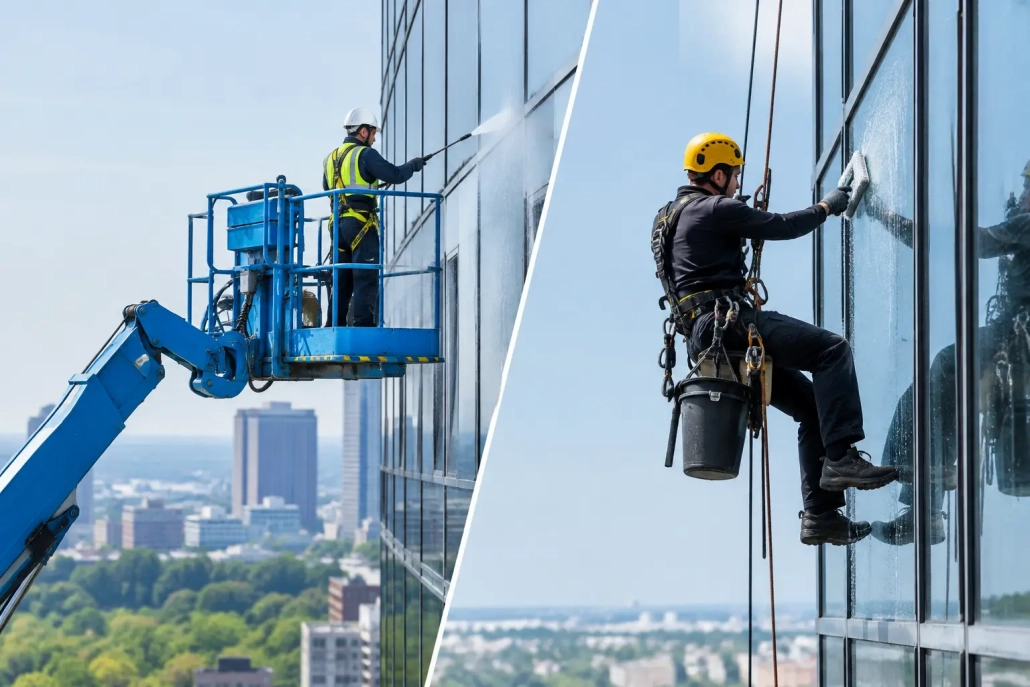
Rope access cleaning involves technicians who are trained to descend, position, and work from ropes anchored at the top of a structure. It is commonly used for high-rise window cleaning, façade work, inspections, and cleaning tasks that require a person to be close to the surface.
The key strength of rope access is hands-on detail. A technician can inspect a problem area at close range, use targeted tools, manually address stubborn residue, and work around features that require careful physical control. For detailed glass work, localized repairs, sealant concerns, or surfaces with unusual architectural elements, direct technician access can be necessary.
That capability comes with more planning. Anchor points must be appropriate, technicians need a safe descent path, and the site below must be managed to protect residents, pedestrians, vehicles, and landscaping. Depending on the project, rope access may also require more time for setup, repositioning, and weather-related delays.
Aerial Washing Versus Rope Access: The Main Differences
The most visible difference is who or what reaches the exterior surface. With aerial washing, a drone does the elevated work while the cleaning team remains on the ground. With rope access, qualified technicians work directly on the structure. That distinction shapes nearly every part of the project.
Safety and liability planning
Rope access is a proven professional method when performed by properly trained crews with suitable safety systems. Still, it involves people working at height. That naturally requires detailed planning around anchors, fall protection, descent routes, weather, and exclusion zones below the work area.
Drone-powered cleaning reduces the need to place a worker on the building for suitable washing tasks. Fewer people at elevation can reduce one major source of risk. It does not eliminate the need for a professional site plan. Operators still need to control the work area, account for wind conditions, protect nearby people and property, and use the right cleaning approach for the surface.
Disruption to residents and operations
For occupied condominiums, hotels, offices, and retail locations, disruption is often as important as the cleaning result. Rope access can require visible ropes, rooftop activity, controlled areas at ground level, and scheduling around building occupants. It may be the right choice, but managers should plan for communication with residents and tenants.
Aerial washing generally has a smaller physical footprint. There is no scaffolding along the façade and no lift taking up parking spaces or blocking a drive aisle. This can be valuable for properties that need to stay open, keep entrances clear, or avoid extended staging in common areas. Cleaning still requires coordination, especially around pool decks, balconies, outdoor dining, and pedestrian traffic, but the setup is often faster and less intrusive.
Cost drivers
Neither method has a universal price advantage. Rope access costs are influenced by building height, roof access, anchor requirements, crew size, the complexity of the descent path, and the amount of manual work needed. Aerial washing costs depend on the size of the surface, building configuration, site conditions, cleaning solution needs, and flight time.
For broad exterior washing on multi-story buildings, aerial service can avoid costs tied to scaffolding, lifts, and lengthy access setup. That can make it an efficient option for routine façade washing, algae treatment, and exterior appearance maintenance. But if the job requires close manual work on every section, rope access may deliver better value because the technician is already in position to inspect and address details directly.
Cleaning precision and surface suitability
Rope access is often better for tasks that demand physical contact and close inspection. A technician can hand-clean a specific area, work around delicate fixtures, remove localized material with specialty tools, or identify conditions that should be referred for repair rather than cleaned.
Aerial washing excels at consistent coverage across large exterior areas. It is a strong fit for surfaces affected by widespread mildew, algae streaking, dust, and weather-related buildup. The right low-pressure chemistry and dwell time matter more than brute force. A professional crew should evaluate whether stucco, paint, siding, metal, roofing materials, seals, windows, and nearby landscaping can safely handle the proposed process.
When Drone-Powered Aerial Washing Makes Sense
Aerial washing is often the practical choice when a property needs broad, visible exterior improvement with minimal access equipment. A condominium tower with stained upper façades, a multi-story office building with limited space for lifts, or a large home with difficult roofline access may all be strong candidates.
It is also useful for proactive maintenance. In South Florida, waiting until organic staining becomes heavy can make a building look older than it is and may lead to a more involved cleaning project. Regular low-pressure exterior care can help maintain curb appeal without turning each service visit into a major construction-style operation.
The Cleaners Drones uses drone-powered exterior cleaning to help properties address those high and hard-to-reach surfaces without scaffolding or lifts when the site and surface are appropriate. The focus is not technology for its own sake. It is using the right access method to deliver a cleaner exterior with less interruption to the property.
When Rope Access Is the Better Choice
Rope access remains the better option when the work calls for a technician’s hands, eyes, and tools at the surface. Detailed window cleaning, close façade inspection, cleaning around complex architectural features, and jobs involving stubborn localized buildup may require direct access.
It can also be necessary when wind, airspace limitations, building geometry, or a surface-specific condition makes drone operation unsuitable. A responsible contractor should be willing to say so. The best exterior cleaning plan is not the one that uses the newest method every time. It is the one that can be performed safely and effectively on that particular building.
In some cases, the strongest approach is a combination. Aerial washing can handle large areas efficiently, while rope access or ground crews address detailed zones that need hands-on attention. That strategy can keep the project moving while reserving more labor-intensive access for the places where it adds real value.
Questions to Ask Before Choosing a Method
Before approving exterior work, ask how the contractor will access the building, protect people and vehicles below, manage runoff, and select cleaning solutions for your surface. Ask whether the proposal includes low-pressure cleaning where appropriate, how weather will affect scheduling, and which areas may require a different method.
It is also worth asking what will happen around balconies, landscaping, entryways, outdoor amenities, and tenant spaces. A clear answer is a good sign. Exterior cleaning should improve the appearance of your property without creating avoidable headaches for the people who live, work, or visit there.
A clean façade is one of the first things residents, customers, and prospective buyers notice. Choose the access method that fits the job, then schedule the work before South Florida moisture turns a manageable cleaning need into a much more noticeable problem.


Leave a Reply
Want to join the discussion?Feel free to contribute!